
An obsession
It’s become an obsession: seeing the world through evolutionary lenses. I’ve been feeling like one of those people who make dad jokes – they know it’s annoying, but they can’t resist making them. Only, instead of making jokes, I find myself theorizing the evolutionary explanation for why the person in front of me is acting that way – in meetings, in traffic, at the grocery store…
The obsession started innocently a few years ago, when I first read On the Origin of Species. I love nature and felt like it was my duty to read the classic. Things escalated. I made trips to the places Darwin had been during his Beagle journey. I read dozens of thick books on the evolution of anything – communication, birth, motherhood, bird migration. I signed up for an animal behavior course at Harvard, watched an embarrassing number of YouTube videos, and now I can’t go one day without instinctively trying to explain every tiny behavior I witness through the evolutionary lens.
I think I now understand why it got me hooked. If you see an animal behaving a certain way, you can try to explain the how – the mechanistic and physiological processes that enable that behavior – or you can try to explain the why – why does that behavior even exist in the species? What’s its function? Evolutionary science is concerned with explaining the why of things, and finding the why is deeply satisfying. It makes the mess of life seem… coherent and logical.
Behind evolutionary theory is natural selection, an unintentional process, described by Darwin and Wallace concomitantly. You need to believe three things to believe in evolution:
a) there’s variation among individuals of the same species;
b) some of those differences help them survive and reproduce better than others;
c) and those traits get passed on.
It sounds obvious today, but back then there was still a belief that animals were made by a divine force the way they were… So now, when I see a behavior, especially the weird and seemingly counterproductive ones (like scrolling social media?), I ask myself: Could this have helped with finding food? Avoiding predators? Finding a mate? Taking better care of babies? All of these potential benefits for reproductive success.

The way researchers test hypotheses in this field is by coming up with predictions that would only make sense if the hypothesis were correct, and then designing experiments around them. For example: if it’s true that parrots gnaw on electricity wires to reduce their stress – a common problem for those living in the tropics – what could we expect to see in an experimental setting? Maybe if we expose them to a stressful environment and offer different materials to chew on, they’d go for the softer ones? And in less stressful environments, maybe they wouldn’t gnaw at all? Another helpful line of thinking: what would happen to a group of parrots that didn’t do this behavior? Can we come up with a hypothesis as to why a lineage of parrots that didn’t chew wires may have had less reproductive success historically?
I just find there’s something really elegant about using this kind of logical, inductive reasoning in a world drowning in data, where so many correlations are left unexplained.
The beetle apocalypse on my porch
Every summer evening my porch turns into a beetle battlefield. Sometimes I find over 30 of them, drawn to the light, slamming into it, falling flat on their backs, stuck there like little overturned tanks. They flail for a while, can’t flip themselves back over, and eventually die. It doesn’t look very smart. Thus the evolutionary question: if beetles weren’t attracted to light, what would they be missing…?
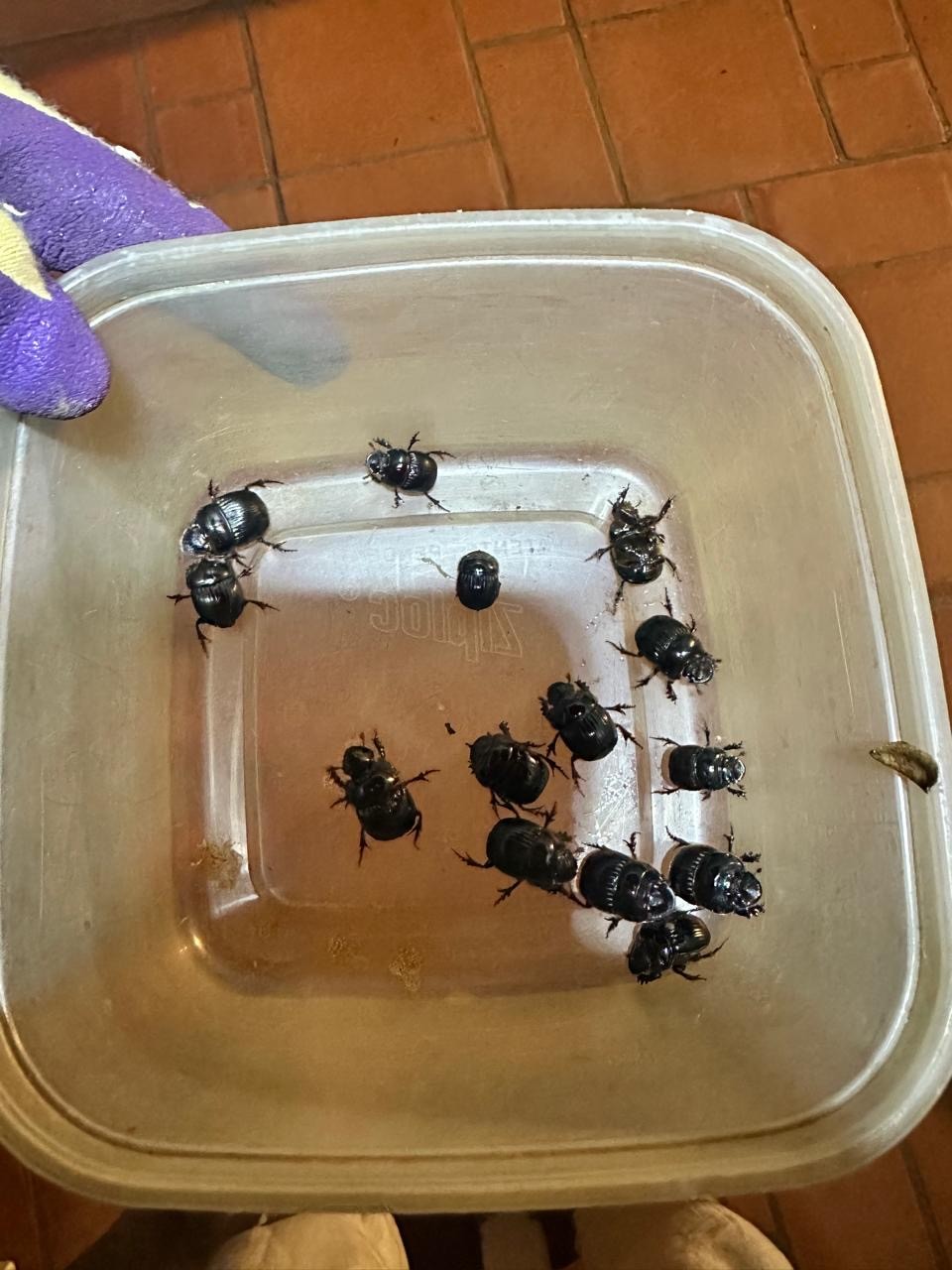
Me on my nightly beetle patrol, collecting fallen beetles to place them back on the garden. Sometimes, I admit, I just flip them upright and let them decide their fate. Some wisely walk away. Others charge straight back into the light and fall again, helpless. A far cry from what I used to do 25 years ago: playing ‘beetle pong’ with my cousins—cushions served as ping-pong paddles and when a new beetle came into the living room, we all tried to smack it to see who’d be the winner in that round.
How could this whole “fly-into-the-light-and-die” behavior possibly be useful in an evolutionary sense? Maybe in nature, more illuminated spaces meant other beetles were nearby and they could find their partners, like today’s dating apps? But evolution works across generations, so what would have been a natural source of light attracting them before artificial lights existed?
Turns out many insects evolved to navigate by the moon. The moon! It’s a steady, faraway light source, so by keeping it at a certain angle, they could fly in straight lines, as if having a compass. But then humans showed up and filled the world with bright lights that are not steady or far. The insects try to use their moon-navigation capabilities, but with nearby lights, it just leads them in circles. So there is a function to this seemingly suicidal behavior. (There was no literature review for these findings, just a satisfying-enough explanation I found on the internet. Don’t cite me.)
Finding harmony with nature
After a while living in nature, I’ve realized that coexisting with it takes two kinds of understanding: the how and the why animals behave. The how-question helps you come up with creative solutions. Studying how light impulses act on beetles’ neural and hormonal pathways, the mechanics of the behavior, led to a discovery that their sensors seem more sensitive to certain wavelengths. Knowing this, I can try using amber lights instead of white ones.
Then why bother asking the why-question? Because the answer to it is always fascinating. It’s the why-answer that puts our human existence into relative perspective against the marvels of nature, and what makes us more “compassionate” to other beings, if you can say so. It’s the answer to the why-question that turns beetles from stupid beetle-pong targets into incredibly adapted creatures with finely tuned navigation abilities beyond our imagination, simply confused by our modern inventions.
The how gives you the solutions to coexist with nature. The why gives you the motivation to do so. I’m now much more keen on doing my little beetle patrol every night, gently flipping them over and giving them a second shot, knowing they’re highly complex creatures and not just dumb and disgusting poop eaters.
 BEATRIZ ZANFORLIN
Leave a comment